Somewhere along the way, it's easy to decide we aren't "arty". Often we can still name the moment: a teacher holding up somebody else's painting, a school choir where we were quietly asked to mouth the words, a story handed back covered in red pen. It's strange how long a moment like that can last. This month brought the Feast of the Transfiguration, and it has something to say about beauty, about making things, and about who gets to do it.
Brené Brown, in her research on shame, found that a striking number of the people she interviewed could recall a moment at school that put them off art, writing or music for good. She calls them creativity scars. They are far more common than we'd guess, and they rarely fade on their own.
Peter Wants to Build Something
Jesus takes Peter, James and John up a high mountain, and there, in front of them, He is transfigured. His clothes become dazzling white, Moses and Elijah appear beside Him, and for a few moments the disciples catch sight of the glory that was His all along.
Peter does what any of us might. He blurts out, "Rabbi, it is good for us to be here; let us make three dwellings." Mark adds, kindly, that he didn't know what to say, because they were all terrified. Faced with more beauty than he could take in, Peter's first instinct was to make something: a shelter, a frame, somewhere to keep the moment.
His plan wasn't quite right, and the voice from the cloud turns him towards what matters: "This is my Son, the Beloved; listen to him." The instinct, though, is a good one. When something beautiful catches us off guard, we reach for a camera, a pen, a tune. Making things is one of the oldest ways human beings say thank you.
Why Bother With Beauty?
A church could meet in a warehouse on plastic chairs, and plenty do, faithfully. So why has the Church spent two thousand years on stained glass, plainchant, carved wood, embroidered vestments and candlelight?
Partly because beauty reaches us before we've decided whether to let it. A song at a funeral can say what none of the speeches managed. A sunset on the A19 can quieten a car mid-argument. For a second we stop being the centre of our own attention, and that small forgetting of ourselves is very close to prayer.
In 1999 Saint John Paul II wrote a letter to artists, and in it he says something easy to miss: every one of us is entrusted with shaping our own life, and making of it, in a sense, a work of art.
Beauty Close to Home
Neither of our churches is a cathedral. Saint Gabriel's, with its 1970s pyramid roof, and Corpus Christi, in its 1950s brick, were both built by people who wanted to give God the best their own generation had, with the materials and the money of their time.
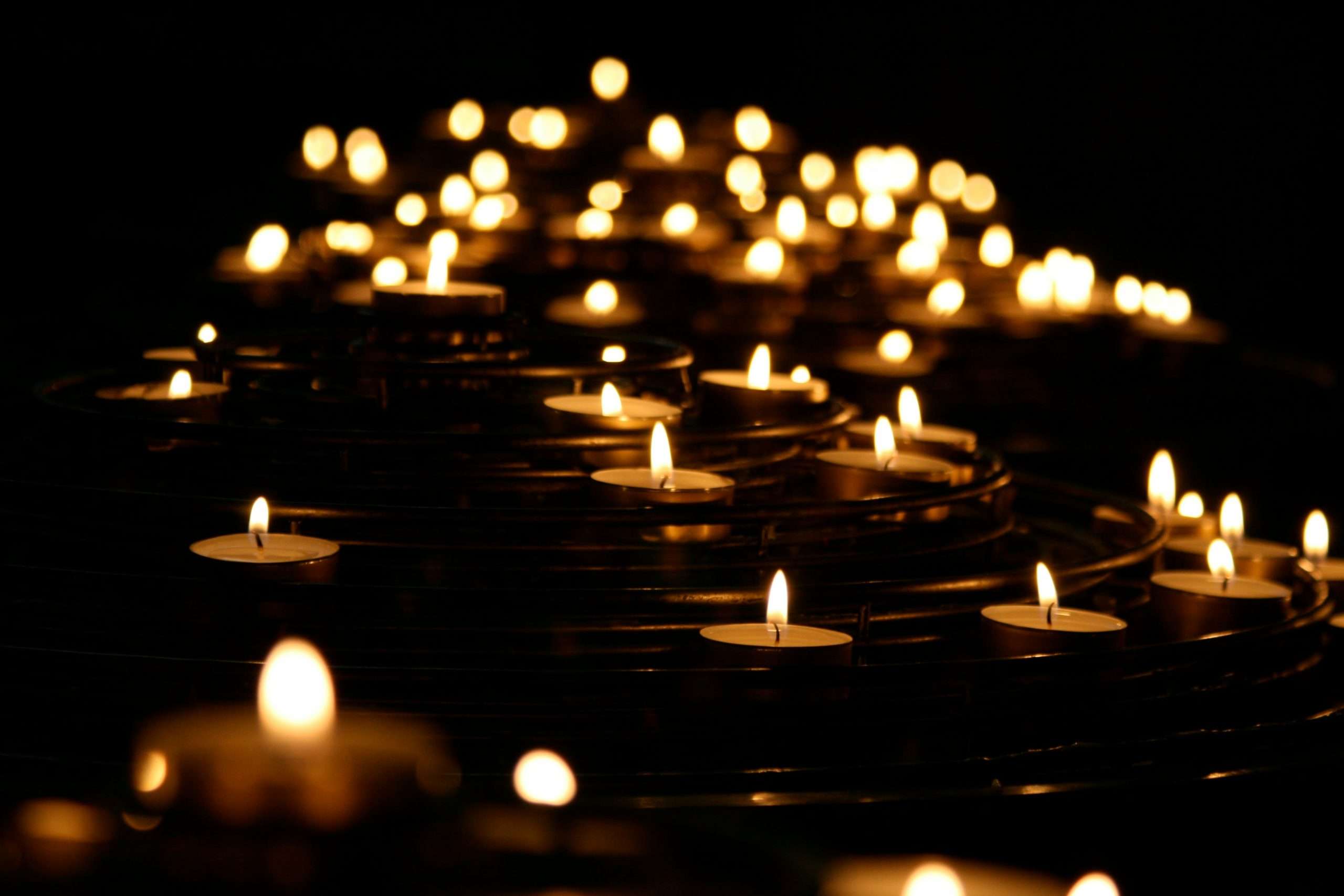
Much of the beauty in them never makes it into a guidebook: flowers arranged on a Saturday morning, an altar cloth washed and ironed, a reading read with care, candles lit before anyone else arrives. Hardly any of it lasts beyond a week. It's beauty made to be used up, offered one Sunday at a time.
Answering Back
For anyone carrying a creativity scar, Peter is good company. Peter's idea was clumsy, badly timed and, by any measure, not very good. Nobody told him to stop. God simply turned his attention towards Jesus.
Nobody is marking what we make, either. A few minutes with a pencil and a leaf from the garden, a hymn sung properly in the car with the windows up, a photo of the light on a wet street, a loaf, a card, a bit of embroidery: none of it has to be shown to anyone. It's a way of looking closely at what God has made, and answering back. We are made in the image of our Creator, and the urge to make is part of that likeness.
Back Down the Mountain
Peter's shelters never got built. The disciples came down the mountain, and Mark tells us they walked straight into a crowd, an argument, and a father begging for help for his son. Whatever they had seen up there went down with them, into the noise.
Pied Beauty
Glory be to God for dappled things –
For skies of couple-colour as a brinded cow;
For rose-moles all in stipple upon trout that swim;
Fresh-firecoal chestnut-falls; finches' wings;
Landscape plotted and pieced – fold, fallow, and plough;
And áll trádes, their gear and tackle and trim.
All things counter, original, spare, strange;
Whatever is fickle, freckled (who knows how?)
With swift, slow; sweet, sour; adazzle, dim;
He fathers-forth whose beauty is past change:
Praise him.
Gerard Manley Hopkins